
Machine Learning
The Complete Guide to Learning, Career Growth, and Real-World Success
Machine Learning: The Complete Guide to Learning, Career Growth, and Real-World Success
In today’s fast-evolving digital economy, machine learning has established itself as one of the most powerful and future-proof skills. It is no longer limited to researchers or large tech companies; instead, it has become a core capability across industries such as finance, healthcare, marketing, and even small startups. From automating repetitive tasks to predicting complex outcomes, machine learning is transforming how decisions are made.
For students, freshers, working professionals, and entrepreneurs, learning machine learning is not just about acquiring a technical skill. It is about building a career advantage that remains relevant in the long term. A well-structured machine learning course can open doors to high-paying roles, innovative opportunities, and the ability to solve real-world problems using data.
This guide will help you clearly understand machine learning, how to start learning it, what tools are required, and how to build a successful career in this field.
What is Machine Learning?
Machine learning is a branch of Artificial Intelligence that enables systems to learn from data and improve their performance over time without being explicitly programmed for every task. Instead of following fixed instructions, machine learning models analyze patterns within data and use those patterns to make predictions or decisions.
For example, when you watch movies on platforms like Netflix or shop on Amazon, the recommendations you receive are powered by machine learning algorithms. Similarly, in finance, machine learning is used to predict stock trends, detect fraud, and optimize trading strategies. Chatbots, voice assistants, and image recognition systems also rely heavily on machine learning techniques.
Understanding these concepts at a foundational level is essential for beginners. A strong introduction to machine learning helps build clarity around how models work, how data is processed, and how predictions are made.
Why You Should Learn Machine Learning in 2026
The demand for machine learning professionals is growing rapidly because organizations are increasingly becoming data-driven. Companies are no longer relying only on experience or intuition; they are making decisions based on data insights, and machine learning plays a central role in this transformation.
Learning machine learning in 2026 provides a significant career advantage. It offers access to high-paying job roles and creates opportunities to work on innovative technologies. Professionals skilled in machine learning are not only in demand in tech companies but also in industries like banking, e-commerce, healthcare, and digital marketing.
Another important reason to learn machine learning is its ability to solve real-world problems. Whether it is predicting customer behavior, automating workflows, or improving operational efficiency, machine learning allows individuals to create impactful solutions. This makes it a valuable skill not just for employees but also for entrepreneurs who want to build scalable and intelligent systems.
Machine Learning for Beginners: Where to Start?
Starting machine learning can feel overwhelming, especially for those who do not come from a technical background. However, with the right approach, it becomes much more manageable.
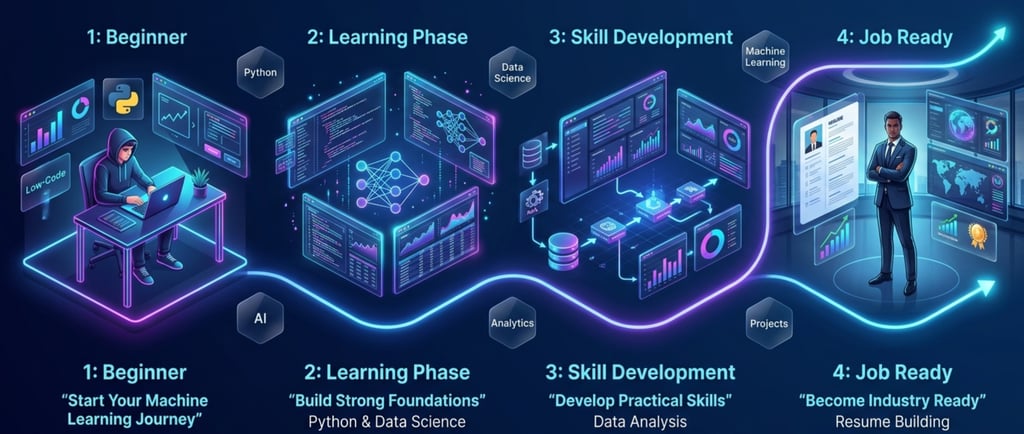
The first step is to build a strong foundation by understanding basic concepts such as data, variables, and simple algorithms. Learning Python is highly recommended because it is the most widely used programming language in machine learning. Once you are comfortable with Python, the next step is to understand how data is prepared and processed, as data preprocessing is a critical part of any machine learning project.
After building this foundation, beginners should focus on simple models like linear regression and classification techniques. These models help in understanding how machine learning works in practice. A beginner-friendly course that provides step-by-step guidance along with practical exercises can significantly improve the learning experience.
From Beginner to Advanced: A Structured Learning Approach
A structured learning path is essential for mastering machine learning. At the foundational level, the focus should be on understanding core concepts such as statistics, probability, and how algorithms function. This stage builds the base required for more advanced topics.
As learners progress to the intermediate level, they start working with different types of machine learning techniques, including supervised and unsupervised learning. At this stage, understanding feature engineering and model evaluation becomes important, as these factors directly impact the performance of machine learning models.
At the advanced level, learners explore deep learning concepts such as neural networks, natural language processing, and computer vision. These advanced topics allow the development of complex applications such as image recognition systems, language translation tools, and AI-driven automation systems. A course that includes real-world projects at this stage helps bridge the gap between theory and practical application.
Tools and Technologies You Must Learn
To become proficient in machine learning, it is important to learn the right tools and technologies. Python serves as the foundation, but it is equally important to understand libraries that simplify data analysis and model building.
Libraries such as NumPy and Pandas are used for handling and analyzing data efficiently. Scikit-learn is widely used for implementing machine learning algorithms, while TensorFlow and Keras are essential for deep learning applications. Understanding how to evaluate models and deploy them in real-world environments is also a crucial skill.
Mastering these tools allows learners to move from theoretical understanding to practical implementation, which is highly valued in the industry.
Data Science and Machine Learning: A Powerful Combination
Machine learning and data science are closely connected fields, and combining them creates a powerful skill set. While data science focuses on analyzing and interpreting data, machine learning focuses on building models that can learn from that data.
By learning both fields together, individuals can gain a deeper understanding of how to extract insights, build predictive models, and solve business problems. This combination is particularly useful in industries where data-driven decision-making is critical.
A program that integrates data science with machine learning prepares learners to handle real-world challenges more effectively and increases their career opportunities.
Career Opportunities in Machine Learning
Machine learning offers a wide range of career opportunities. Professionals in this field can work as machine learning engineers, data scientists, AI engineers, business analysts, or automation specialists. Each of these roles involves working with data, building models, and solving practical problems.
To succeed in these roles, it is important to focus not only on technical skills but also on career preparation. Building a strong resume, creating a portfolio of projects, and preparing for interviews are essential steps. Many training programs now include internship opportunities and placement support, which can help learners transition smoothly into the industry.
Practical Learning: The Key to Success
Machine learning cannot be mastered through theory alone. Practical experience is essential for developing real skills. Working on live projects helps learners understand how to apply concepts in real-world situations. It also improves problem-solving abilities and builds confidence.
Assignments, case studies, and real-world applications play a crucial role in the learning process. Without hands-on practice, it becomes difficult to understand how machine learning models behave in different scenarios. Therefore, choosing a course that emphasizes practical learning is extremely important.
Machine Learning in Real Life and Business
Machine learning is transforming industries by enabling smarter and faster decision-making. In finance, it is used for stock market prediction and risk analysis. In marketing, it helps in understanding customer behavior and improving targeting strategies. Startups use machine learning to scale their operations and make data-driven decisions, while automation systems use it to optimize processes and reduce manual effort.
This widespread adoption of machine learning highlights its importance as a future skill. It is no longer optional but essential for individuals who want to stay competitive in the modern job market.
Future Skills: AI and Machine Learning
The future of technology lies in the integration of artificial intelligence and machine learning. As automation continues to grow, professionals who understand both fields will have a significant advantage.
Emerging areas such as AI-driven automation, digital transformation, and intelligent systems are creating new opportunities. Additionally, the rise of AI prompting and human-AI collaboration is changing how people interact with technology. Learning these skills ensures long-term career growth and adaptability.
How to Choose the Best Machine Learning Course?
Choosing the right course is one of the most important decisions in your learning journey. A good course should provide a balance between theory and practical training. It should include real-world projects, certification, and opportunities for internships.
Affordability and placement support are also important factors to consider. For learners in India, especially in regions like Rajasthan, finding a reliable training institute nearby can provide additional benefits such as mentorship and networking opportunities.
The right course not only teaches concepts but also prepares you for real-world challenges and job opportunities.
Why Choosing the Right Institute Matters
A high-quality training institute plays a crucial role in shaping your learning experience. It provides structured guidance, expert mentorship, and exposure to real-world applications. A good institute focuses on building practical skills rather than just theoretical knowledge.
Institutes that offer job-oriented training, real projects, and career guidance provide better outcomes for students. They help learners become industry-ready and confident in their abilities.
Machine Learning Roadmap 2026
Building a successful career in machine learning requires a clear roadmap. The journey begins with learning Python and understanding the fundamentals of machine learning. This is followed by working on projects to gain practical experience.
As learners progress, they should focus on mastering advanced tools and technologies, building a strong portfolio, and applying for internships. Preparing for interviews and continuously improving skills are essential for long-term success.
Consistency, practice, and real-world application are the key factors that determine success in this field.
Final Thoughts
Machine learning is more than just a technical skill; it is a powerful career accelerator that opens doors to innovation and growth. Whether you want to switch careers, advance in your current role, or build your own startup, machine learning provides the tools to achieve your goals.
By focusing on practical learning, building real-world projects, and following a structured approach, anyone can succeed in this field. The journey may require effort and dedication, but the rewards are significant.
The future belongs to those who not only learn machine learning but also apply it effectively to solve real-world problems.