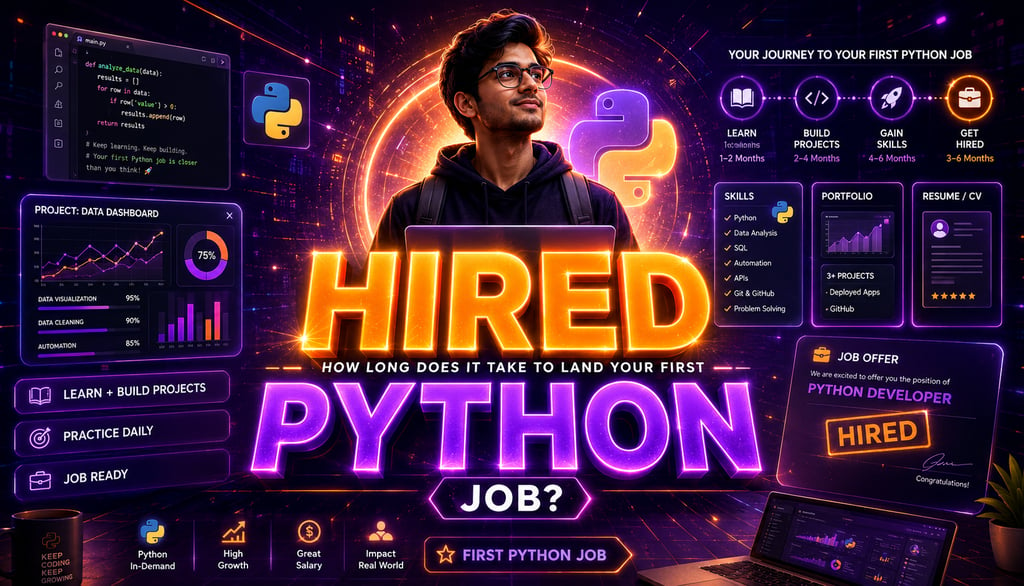
How Long Does It Take to Land Your First Python Job?
Wondering how much time it takes to get your first Python job? This blog explains the realistic timeline for beginners, freshers, students, and career switchers to learn Python, build projects, prepare for interviews, and apply for Python developer jobs. Learn what skills you need, how long each stage takes, and how to speed up your journey from learning Python to getting hired.
5/12/20267 min read
How Long Does It Take to Land Your First Python Job?
In today’s digital world, learning python is no longer just a technical hobby. It has become one of the most powerful career opportunities for students, freelancers, developers, and tech enthusiasts who want to build a future in software, AI, automation, and modern technology. Whether someone starts with a simple python tutorial, joins a python course, watches a python full course, or begins learn python lessons through a python online course, the biggest question almost everyone asks is: How long does it really take to get your first Python job?
The answer depends on consistency, practical learning, project-building, and how deeply you understand the python programming language. For some learners, the journey may take three to six months, while for others it can take up to one year. But one thing is certain — the demand for python developers is growing faster than ever because industries everywhere are using python programming for web apps, artificial intelligence, data science, cloud systems, automation, and business solutions.
The reason why millions of people choose python for beginners is because Python is considered a python easy programming language. The syntax is simple, readable, and beginner-friendly. A student with zero technical background can start learning python basics within a few days using an easy python tutorial or a python crash course. As beginners practice python coding, they slowly understand concepts like python syntax, python functions, python loops, python arrays, python dictionary, python list comprehension, and object oriented programming python concepts.
The first month of learning usually focuses on understanding core programming fundamentals. During this stage, learners practice python examples, solve python exercises, attempt python quiz questions, and improve their skills through python coding practice. Many students also use a python cheat sheet, python pdf notes, and python coding examples to strengthen their understanding. Beginners often install tools like vscode python, explore pycharm tutorial setups, or use jupyter notebook and google colab python environments to practice coding.
Most successful learners follow a proper python roadmap or python learning roadmap because random learning creates confusion. A structured python study plan helps students move from beginner to advanced levels smoothly. During the second and third month, students begin building python mini projects, experimenting with python practical projects, and creating python coding projects that improve real-world skills. These projects are extremely important because companies do not only look for certificates; they look for practical experience and problem-solving ability.
As learners grow, they start exploring specialized areas like python web development, machine learning with python, python automation, and python data science. Many beginners become interested in django, flask python, or fastapi because these technologies are widely used for backend systems and modern web applications. Building a python web app using a python web framework is one of the fastest ways to become job-ready. Frameworks like Django and Flask help beginners learn python backend development, python api development, python server development, and python website development.
Developers who choose the web development path often practice mysql with python, sqlite python, mongodb python, and postgresql python integration for database handling. They also learn python deployment, python hosting, and python cloud development to understand how modern applications run online. Many aspiring developers dream of becoming a python full stack developer, where they work on both frontend and backend technologies while managing complete application systems.
Another fast-growing career path is ai with python and python for machine learning. The rise of artificial intelligence has created massive demand for developers skilled in tensorflow python, pytorch python, scikit learn, and neural network python technologies. Students interested in artificial intelligence python often combine coding with mathematics, analytics, and deep learning concepts. This field may require more learning time, but it also offers incredible career opportunities and high salaries.
The popularity of python data analysis and data analytics with python has also increased because businesses are now dependent on data-driven decisions. Tools like pandas python, numpy tutorial, matplotlib python, and seaborn python are widely used in analytics, business intelligence, and visualization. Many students work on python data science projects, business analytics python, and python predictive analytics projects to build strong portfolios that impress recruiters.
A strong portfolio is often the biggest factor in reducing the time required to land your first job. Beginners who only watch tutorials usually struggle in interviews, while those who create python real world projects, python github projects, and python open source projects become more attractive to employers. Companies want developers who can build applications, solve problems, and work independently. Creating python automation projects, python ai projects, or python portfolio projects can significantly improve job opportunities.
Automation is another highly profitable field. Businesses everywhere are using automation with python to save time and reduce manual work. Beginners learn python scripting, create python automation scripts, and experiment with web scraping with python using tools like selenium python and beautifulsoup python. Some learners build bots through telegram bot python, discord bot python, or even python email automation systems. These projects not only improve technical skills but also help beginners earn through freelancing and remote work.
The gaming industry also provides opportunities through python games and game development with python. Beginners explore pygame tutorial resources to build simple games and interactive applications. Others move toward desktop software using tkinter python or mobile applications through python mobile app development frameworks. These practical skills help students create impressive portfolios and gain confidence in software development.
Many learners also explore cybersecurity fields like ethical hacking with python, python penetration testing, python networking, and python security tools. Python is widely used in cybersecurity because it simplifies automation and security analysis. Similarly, industries like finance and blockchain are adopting Python rapidly through python fintech, python blockchain, python crypto projects, python stock market analysis, python trading bot, and python algorithmic trading systems.
One of the reasons why Python careers are growing so fast is because the language is flexible. Students can use Python in artificial intelligence, cloud computing, analytics, backend systems, mobile apps, bots, cybersecurity, startups, and automation. This versatility creates endless opportunities for beginners. A learner who starts with python coding for beginners can eventually become a professional python developer, python engineer, or even a startup founder.
The modern hiring process has also changed dramatically. Today, many companies focus more on skills than degrees. A beginner with strong python programming skills, real projects, and practical experience often gets selected faster than someone with only theoretical knowledge. Recruiters usually test problem-solving through python coding interview, python coding test, and python interview questions. Practicing coding challenges regularly improves confidence and interview performance.
For beginners searching for their first opportunity, internships and freelance projects are extremely valuable. Many learners start through a python internship, work on python startup projects, or become a freelance python developer. Platforms like GitHub, Upwork, and Fiverr help developers showcase their skills globally. Even small freelance projects can build real-world experience and improve portfolios.
The rise of remote work has made remote python jobs and python work from home jobs more accessible than ever before. Companies are hiring developers globally for backend systems, APIs, AI tools, analytics dashboards, and automation solutions. This means students no longer need to move to large cities to start their careers. A good portfolio, strong communication skills, and practical coding ability can help anyone access international opportunities.
Many students wonder whether they should join a python bootcamp, buy the best python course, or start with a free python course. The reality is that learning resources are everywhere. Some students prefer python classes online, while others follow a python masterclass, python expert tutorial, or python practical tutorial on YouTube and learning platforms. What matters most is not the platform but consistency and practical implementation.
Students from India are especially showing strong interest in Python because the python demand in india is increasing rapidly. Companies are hiring developers for AI, automation, analytics, and cloud-based systems. This has made Python one of the most important python high paying skills in the technology industry. The future looks even stronger because experts believe the future of python will continue growing with AI and automation trends.
Many beginners compare python vs java, python vs c++, or python vs javascript before starting. While every language has its strengths, Python remains one of the easiest entry points for beginners due to readability, simplicity, and massive industry demand. The python advantages include fast development, easy syntax, powerful libraries, and huge community support.
Another important factor is mindset. Learning coding is not always easy. There will be bugs, errors, failed interviews, and moments of frustration. But the students who succeed are those who continue practicing even during difficult phases. Following a python coding roadmap for beginners, solving python practice questions, participating in a python hackathon, and building projects consistently creates long-term success.
The timeline to become job-ready depends heavily on effort. A person studying casually for one hour daily may take a year or more, while someone focused on daily practice and projects can become interview-ready within a few months. Most beginners who follow a solid python developer roadmap, build projects consistently, and prepare for interviews seriously can start applying for python fresher jobs within six to eight months.
The best strategy is to combine learning with building. Instead of endlessly consuming tutorials, learners should create projects, upload work on GitHub, contribute to communities, and improve practical understanding. Building a python chatbot, creating chatbot with python systems, designing analytics dashboards, or developing automation tools can make a portfolio stand out dramatically.
In 2026, Python continues to dominate technology trends. From startups to global corporations, businesses are investing heavily in AI, automation, analytics, and cloud infrastructure. This is why python trends 2026 show massive growth in hiring opportunities for developers, analysts, engineers, and AI specialists. Python is not just a language anymore — it has become a complete ecosystem for innovation and digital transformation.
For anyone wondering whether it is worth starting, the answer is simple. If you stay consistent, follow a proper roadmap, build real projects, and practice regularly, getting your first Python job becomes completely achievable. The journey may take months of hard work, but the reward is a future-proof career filled with opportunities in software development, artificial intelligence, automation, freelancing, startups, and remote work.
The first Python job is not only about earning money. It represents transformation — from beginner to creator, from learner to developer, and from curiosity to career. Whether your goal is becoming a junior python developer, building AI systems, working in data science, launching startup ideas, or exploring global freelance opportunities, Python opens the door to endless possibilities. The key is to start learning today, stay patient, and keep building because every line of code moves you one step closer to success.