
Best Platforms for Finding Python Jobs: Complete Guide for Beginners, Freshers, Freelancers, and Professionals
Looking for your first Python job or planning to grow your Python career? This complete guide explains the best platforms to find Python developer jobs, internships, freelance projects, remote roles, and entry-level opportunities. Learn how beginners, freshers, freelancers, and working professionals can use platforms like LinkedIn, Naukri, Indeed, Internshala, Upwork, Fiverr, company career pages, remote job boards, and tech communities to apply smartly and get hired faster.
5/14/202614 min read
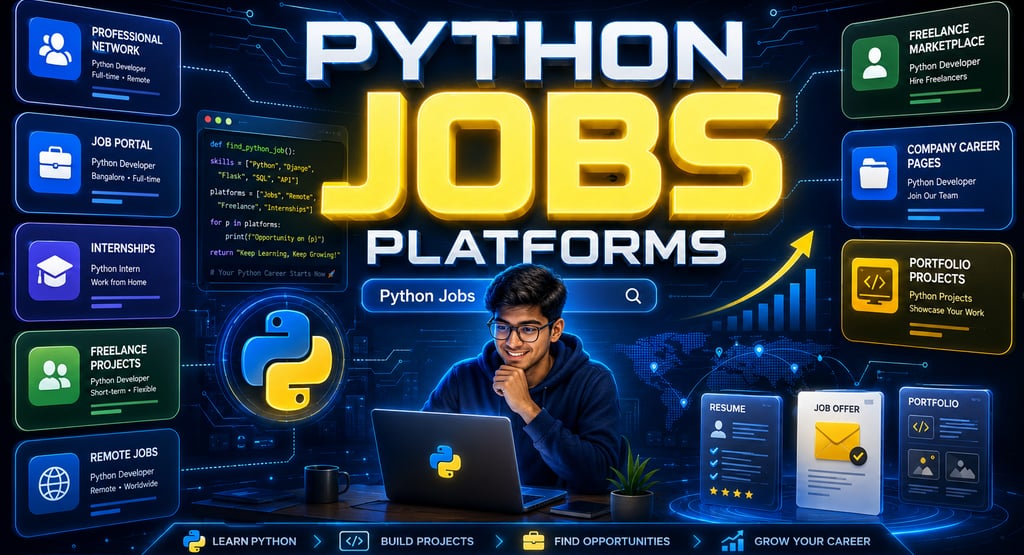
Introduction: Why Python Jobs Are in High Demand
Python is one of the most career-friendly programming languages today because it is used in software development, data science, machine learning, artificial intelligence, automation, web development, finance, analytics, and backend development. For students, beginners, freshers, working professionals, and career switchers, Python can open multiple career paths such as Python developer, backend developer, data analyst, automation engineer, machine learning beginner, Django developer, Flask developer, and freelance Python programmer.
But learning Python is only the first step. To build a successful Python developer career, you must also know where to find the right opportunities. Many beginners search for Python jobs randomly and apply without a strong profile, resume, portfolio, or project proof. This reduces their chances of getting shortlisted.
The right Python job platforms help you find Python developer jobs, Python internship opportunities, Python remote jobs, entry level Python jobs, and Python freelance jobs according to your skill level. Some platforms are better for freshers, some are better for experienced professionals, some are best for freelancing, and some are useful for remote international work.
In this article, you will learn the best websites for Python jobs, how to use each platform effectively, what keywords to search, how to build a strong profile, and how beginners can get their first Python job.
1. LinkedIn: Best Platform for Networking and Professional Python Jobs
LinkedIn is one of the most powerful platforms for Python developer jobs because it combines job search, networking, personal branding, recruiter visibility, and professional credibility. LinkedIn describes itself as a professional community where users can manage their professional identity, build a network, and access opportunities. (LinkedIn)
LinkedIn is best for freshers, experienced professionals, career switchers, remote job seekers, and students who want to build a professional image. You can find Python programming jobs, Python backend developer jobs, Python data analyst jobs, Python internship roles, and Python remote jobs.
To create a strong LinkedIn profile, use a clear headline such as “Python Developer | Django | Flask | SQL | Data Analysis | Open to Internships.” Add a professional photo, strong About section, project links, GitHub link, resume, certificates, and skills like Python, SQL, Git, APIs, Django, Flask, Pandas, NumPy, and problem solving.
Search using keywords like “Python developer fresher,” “Python internship,” “entry level Python developer,” “Python remote jobs,” “Django developer fresher,” “Python data analyst,” and “junior Python developer India.” Apply smartly by sending a short personalized note to recruiters and connecting with HR professionals, founders, and developers.
Common mistakes to avoid are using an empty profile, writing “student” only in the headline, not adding projects, sending the same message to everyone, and applying without reading the job description.
2. Naukri: Best for Python Jobs in India
Naukri is one of the most popular job portals in India and is especially useful for Python jobs in India, fresher roles, IT service company jobs, startup jobs, and experienced developer positions. It is a strong platform for students and professionals looking for full-time Python developer jobs.
Naukri works well for freshers, 0–3 year experience candidates, and professionals looking for jobs in Indian companies. You can find roles like Python developer, backend developer, automation engineer, Django developer, Flask developer, data analyst, software trainee, and junior software engineer.
To use Naukri properly, complete your profile 100%. Add your current city, preferred locations, skills, resume headline, employment status, education, projects, and certifications. Use a resume headline like “Python Developer Fresher with Projects in Django, SQL, APIs, and Data Analysis.”
Search using keywords like “Python fresher,” “Python developer 0 years,” “Django developer fresher,” “Python internship,” “Python trainee,” “software developer Python,” and “Python developer work from home.” Update your profile regularly because active profiles often get better visibility.
Avoid applying to every job blindly. Read the experience requirement, notice period, salary range, and required skills. Do not use a generic resume for every job.
3. Indeed: Best for Wide Job Search and Entry-Level Python Roles
Indeed is useful because it collects job listings from many companies and job boards. It is good for entry level Python jobs, internships, remote roles, and local job opportunities. Beginners can use Indeed to compare job descriptions and understand what companies expect from Python developers.
Indeed is suitable for freshers, job seekers in small cities, working professionals, and remote job seekers. You can search for Python developer jobs, Python automation jobs, Python backend roles, and Python data jobs.
Create a simple but complete profile and upload an ATS-friendly resume. Use search filters such as location, salary, experience level, remote, full-time, internship, and fresher. Search for “Python developer fresher,” “junior Python developer,” “Python intern,” “entry level Python,” and “Python developer remote.”
A common mistake on Indeed is applying without customizing your resume. If the job requires Django and SQL, your resume should clearly show Django and SQL projects.
4. Internshala: Best for Python Internships and Freshers
Internshala is one of the most beginner-friendly platforms for Python internship opportunities in India. Its app listing says users can find work-from-home, part-time, in-office, and international internships and jobs. (Google Play)
Internshala is best for students, college learners, 12th pass students learning coding, freshers, and beginners who want their first practical experience. You can find Python internship, Django internship, data science internship, machine learning internship, web scraping internship, automation internship, and data analysis internship opportunities.
To apply effectively, write a strong Internshala profile summary. Mention your Python skills, projects, availability, and learning attitude. Add GitHub links, project demos, certificates, and a short cover letter.
Search using “Python internship,” “Django internship,” “Data science internship Python,” “Machine learning internship,” “Python work from home internship,” and “Python automation internship.”
Avoid unpaid internships that do not offer real learning, fake certificate-based internships, or companies asking for payment. Always verify the company before accepting an offer.
5. Wellfound / AngelList: Best for Startup Python Jobs
Wellfound, earlier known as AngelList Talent, is a strong platform for startup jobs. Wellfound lists startup jobs across locations and remote roles and shows startup-focused opportunities, including software engineering, data, analytics, and remote roles. (wellfound.com)
This platform is best for developers who want to work in startups, build real products, learn fast, and work with smaller teams. Python jobs on Wellfound may include backend developer, AI startup developer, data engineer, automation developer, API developer, and full-stack roles using Python.
To create a strong profile, write about your projects, startup mindset, problem-solving ability, GitHub work, APIs, databases, and ability to learn quickly. Startups care more about practical skills than only degrees.
Search for “Python developer,” “backend engineer Python,” “Django developer,” “Flask developer,” “AI engineer Python,” “data engineer Python,” and “remote Python developer.”
Common mistakes include applying with a corporate-style generic resume, not showing projects, and not explaining why you are interested in the startup.
6. GitHub Jobs Alternatives: Use GitHub, Open Source, and Developer Communities
GitHub Jobs is no longer the main job board it once was, so beginners should use GitHub differently. Instead of treating GitHub as a job portal, use it as a portfolio platform. Your GitHub profile can become proof of your Python skills for jobs.
For Python developer jobs, GitHub helps you show projects such as Django websites, Flask APIs, automation scripts, web scraping tools, data analysis notebooks, machine learning models, portfolio websites, and open-source contributions.
Good GitHub Jobs alternatives include LinkedIn, Wellfound, Remote OK, We Work Remotely, company career pages, Hacker News “Who is Hiring” threads, Stack Overflow community links, and open-source communities.
To make GitHub useful, write clean README files, add screenshots, explain project features, mention technologies used, and include setup instructions. Do not upload empty repositories or copied projects without understanding them.
7. Hirect: Useful for Startup and Direct Recruiter Conversations
Hirect is useful for candidates who want faster communication with recruiters, especially in startups and growth-stage companies. It is better for active job seekers who can respond quickly and explain their skills confidently.
Python jobs available on Hirect may include junior Python developer, backend developer, software engineer, startup developer, and remote or hybrid roles.
Create a short, clear profile. Mention your strongest skills first: Python, Django, Flask, SQL, REST API, Git, Pandas, NumPy, or automation. Keep your resume ready and reply professionally.
Search for Python developer jobs, backend developer jobs, fresher Python roles, and startup developer openings. Avoid sounding desperate or sending incomplete messages.
8. CutShort: Best for Skill-Based Tech Hiring
CutShort is useful for tech professionals because it focuses more on skills, matching, and direct hiring. It is suitable for freshers with good projects, experienced developers, and candidates looking for startup or product-based company roles.
Python jobs on CutShort may include backend developer, data engineer, Django developer, Flask developer, full-stack developer, and automation engineer roles.
To use CutShort effectively, complete your skill profile honestly. Add skill ratings only for technologies you can explain in an interview. Upload your resume, add projects, and keep your job preferences updated.
Search for “Python backend developer,” “Django developer,” “Python fresher,” “Python remote,” and “Python data engineer.”
Avoid overrating yourself in skills. If you mention machine learning, SQL, Django, or APIs, be ready to explain them.
9. Upwork: Best for Python Freelance Jobs
Upwork is one of the best platforms for Python freelance jobs. It is useful for people who want project-based income, remote clients, international work, and freelancing experience.
Python freelance projects on Upwork can include automation scripts, web scraping, data cleaning, Excel automation, API integration, Django websites, Flask APIs, chatbot development, data analysis, and machine learning prototypes.
Create a niche profile instead of a general one. For example, “Python Automation Developer,” “Python Web Scraping Expert,” “Django Backend Developer,” or “Python Data Analyst.” Add portfolio samples, project screenshots, and clear service descriptions.
Search for “Python automation,” “web scraping Python,” “Django developer,” “Python API,” “data cleaning Python,” “Pandas,” and “Python script.”
Common mistakes include bidding too low, copying proposals, applying to projects you cannot complete, and not asking clear questions before accepting work.
10. Fiverr: Best for Selling Python Services as Packages
Fiverr is different from job portals. Instead of applying to jobs, you create service packages called gigs. It is good for beginners who want to sell specific Python services.
You can create gigs like “I will write Python automation scripts,” “I will do web scraping using Python,” “I will fix Python bugs,” “I will create a Flask API,” or “I will clean Excel data using Python.”
Fiverr is best for freelancers, students, and beginners who can offer small but useful services. Your gig title, image, description, pricing, and delivery time matter a lot.
Use keywords like Python script, Python automation, web scraping, data cleaning, Django website, Flask API, and Python bug fixing.
Avoid promising complex work at very low prices. Start with simple services and collect good reviews.
11. Freelancer: Good for Project-Based Python Work
Freelancer is another platform for Python freelance jobs. You can bid on projects related to automation, data scraping, web development, API integration, bots, and data processing.
It is useful for freelancers who are comfortable competing with many applicants. Beginners can start with small projects to build confidence.
Create a profile that shows specific Python services and previous work. Write customized bids explaining how you will solve the client’s problem.
Avoid fake projects, clients asking to communicate outside the platform too early, and projects that sound unclear or unrealistic.
12. Toptal: Best for Highly Skilled Freelancers
Toptal is not beginner-focused. It is a premium freelance platform for experienced professionals. Toptal describes itself as an exclusive network of top software developers, designers, marketing experts, consultants, product managers, and project managers. (Toptal)
This platform is best for experienced Python developers who already have strong technical skills, communication skills, and professional project experience.
Python work on Toptal may include backend architecture, enterprise software, AI systems, data engineering, automation, and high-quality development projects.
Beginners should not start here. First build skills, projects, freelance experience, and client communication ability. Later, Toptal can become a premium opportunity.
13. Remote OK: Best for Python Remote Jobs
Remote OK is useful for finding remote developer jobs, including Python remote jobs. Its Python job page lists remote Python roles and salary ranges for many jobs. (Remote OK)
Remote OK is best for developers who want international remote jobs, work-from-home opportunities, and async work environments.
Search for “Python,” “Backend Python,” “Django,” “Flask,” “Data Engineer Python,” and “Remote Python Developer.” Make sure your resume clearly shows remote-work skills such as communication, documentation, Git, project ownership, and independent problem solving.
Avoid applying to senior remote jobs if you are a complete beginner. Remote companies usually expect strong self-management and practical experience.
14. We Work Remotely: Best for Remote Software Developer Jobs
We Work Remotely is another strong remote job platform. It has categories such as programming, full-stack programming, backend, frontend, software development, design, DevOps, product, and customer support. (We Work Remotely)
This platform is best for experienced professionals, remote workers, and developers with strong portfolios. Python jobs may appear under backend development, software development, full-stack development, data, and DevOps categories.
Use search terms like Python, Django, Flask, backend, software developer, API developer, and data engineer. Read job descriptions carefully because many remote roles require timezone overlap and strong English communication.
15. Glassdoor: Best for Company Research and Salary Insights
Glassdoor is useful not only for applying to Python developer jobs but also for researching companies, salary ranges, interview experiences, and employee reviews.
Freshers can use Glassdoor to understand Python developer salary expectations, interview questions, company culture, and required skills. Before applying, check whether the company is suitable for beginners, offers learning opportunities, and has a good work environment.
Search for Python developer, junior Python developer, backend developer Python, and data analyst Python. Use Glassdoor mainly for research before interviews and salary discussions.
16. Company Career Pages: Best for Direct Applications
Many good jobs are posted directly on company websites before appearing on job portals. Company career pages are useful for serious applicants who already know which companies they want to target.
Make a list of companies in IT services, SaaS, fintech, edtech, analytics, AI startups, digital agencies, and product companies. Visit their career pages weekly and search for Python developer, software engineer, backend developer, data analyst, and internship roles.
Direct applications work better when your resume and cover letter are customized. Mention why you want to work at that company and how your Python skills match the role.
17. Telegram and WhatsApp Job Communities
Telegram and WhatsApp job groups can help you discover Python jobs for freshers, Python internships, walk-in interviews, local openings, and remote opportunities. These groups are useful for quick updates, but you must be careful.
Many fake internship and job scams circulate through informal groups. Reports of internship scams have warned students to verify sources, avoid urgent payment-based offers, and check official contact details before applying. (The Times of India)
Use these communities for leads, but verify every company on LinkedIn, Google, official websites, and job portals. Never pay money for a job or internship certificate.
18. Local Job Portals and Offline Networking
For students in cities like Sri Ganganagar, Jaipur, Chandigarh, Delhi, Hanumangarh, Suratgarh, and nearby areas, local networking can be very powerful. Many small IT companies, coaching institutes, digital marketing agencies, startups, and local businesses need Python automation, websites, dashboards, and data work but may not post jobs on big portals.
Visit local IT companies, attend seminars, connect with trainers, ask seniors, join college placement groups, and build relationships with local business owners. Offline networking is especially useful for internships and first projects.
If you are learning from an offline Python course in Sri Ganganagar or a coding institute, ask your mentor for project guidance, resume review, mock interviews, and internship references.
Best Keywords to Search for Python Jobs
Use specific keywords instead of only searching “Python jobs.” Better searches include:
Python developer jobs
Python jobs for freshers
Python internship
Python remote jobs
Python freelance jobs
entry level Python jobs
junior Python developer
Python developer fresher
Django developer fresher
Flask developer jobs
Python backend developer
Python automation jobs
Python data analyst jobs
Python programming jobs
Python jobs in India
Python developer work from home
Python course with projects and job support
Python course after 12th for high salary career
Python course for data analyst jobs
Python for data science jobs
Python for freelancing jobs
Example Job Search Queries
Search like this:
“Python developer fresher jobs in India”
“Python internship work from home”
“Entry level Python developer remote”
“Django developer fresher jobs”
“Python automation freelance projects”
“Python web scraping jobs Upwork”
“Junior Python backend developer jobs”
“Python data analyst internship”
“Python developer jobs near me”
“Python jobs in Sri Ganganagar”
“Python jobs in Rajasthan”
Difference Between Job Portals and Freelancing Platforms
Job portals like LinkedIn, Naukri, Indeed, Glassdoor, Wellfound, CutShort, and company career pages are mainly for full-time jobs, internships, and long-term employment. They are better if you want stable salary, structured learning, office culture, and career growth.
Freelancing platforms like Upwork, Fiverr, Freelancer, and Toptal are for project-based work. They are better if you want flexible income, international clients, remote projects, and business experience. But freelancing requires communication, pricing, client handling, delivery discipline, and portfolio proof.
Beginners should first build strong Python skills, complete projects, create a resume, upload work on GitHub, and then use both job portals and freelancing platforms.
Tips to Improve Your LinkedIn Profile for Python Jobs
Your LinkedIn profile should clearly tell recruiters what you can do. Use a professional headline with your main skills. Write an About section that explains your Python journey, projects, and career goal. Add your GitHub, resume, certifications, and project links.
Post regularly about your learning journey. Share screenshots of projects, explain what you built, write short posts about Python concepts, and connect with recruiters. A strong LinkedIn profile can bring inbound opportunities, especially for Python developer jobs and internships.
Tips to Build a Python Portfolio
A Python portfolio is more important than only saying “I know Python.” Build projects that solve real problems. Good beginner projects include expense tracker, student management system, weather app using API, web scraper, resume parser, automation tool, Django blog, Flask API, data analysis dashboard, and machine learning prediction model.
Each project should have a clear title, problem statement, features, technologies used, screenshots, GitHub link, and live demo if possible.
Resume Tips for Python Developers
Keep your resume clean and ATS-friendly. Add a strong summary, technical skills, projects, education, certifications, and internship experience. Use keywords from job descriptions such as Python, Django, Flask, SQL, Git, REST API, Pandas, NumPy, HTML, CSS, JavaScript, automation, data analysis, and problem solving.
For freshers, projects should be the strongest section. Do not write fake skills. If you mention a technology, be ready to answer interview questions.
Importance of GitHub Projects
GitHub is proof of your coding ability. Recruiters may not check every line of code, but a clean GitHub profile creates trust. Add meaningful repositories, proper README files, screenshots, installation steps, and project explanations.
For beginners, GitHub can separate you from candidates who only have certificates but no practical work.
How Beginners Can Get Their First Python Job
Beginners should follow a simple roadmap. First, learn Python basics properly. Then learn Git, GitHub, SQL, APIs, and one framework like Django or Flask. After that, build 4–6 practical projects. Create a resume, LinkedIn profile, and GitHub portfolio. Apply daily on LinkedIn, Naukri, Internshala, Indeed, and company career pages.
Do not wait to become perfect. Apply consistently, improve after every rejection, and keep building better projects.
Final Checklist Before Applying
Before applying for Python developer jobs, make sure your resume is updated, LinkedIn profile is complete, GitHub has clean projects, portfolio links are working, skills match the job description, and you have practiced basic interview questions.
Also check whether the company is genuine, the role is clear, and the job does not ask for payment. Apply with confidence but keep learning every week.
FAQsWhich platform is best for Python jobs?
LinkedIn, Naukri, Indeed, Wellfound, CutShort, and company career pages are some of the best platforms for Python jobs. LinkedIn is best for networking, Naukri is strong for Python jobs in India, Internshala is useful for internships, and Remote OK or We Work Remotely are better for remote jobs.
Can freshers get Python jobs?
Yes, freshers can get Python jobs, but they need practical skills, projects, GitHub proof, resume quality, and consistent applications. Freshers should target Python internship, trainee developer, junior Python developer, Django fresher, and entry level Python jobs.
Where can I find Python internships?
You can find Python internships on Internshala, LinkedIn, Naukri, Indeed, company career pages, college placement groups, Telegram communities, and local IT companies. Always verify the company before accepting an internship.
Which platform is best for Python freelancing?
Upwork, Fiverr, Freelancer, and Toptal are popular platforms for Python freelance jobs. Beginners can start with Fiverr and Upwork for small Python automation, web scraping, data cleaning, and bug-fixing projects. Toptal is better for experienced developers.
How can I get a Python job without experience?
Build projects, upload them on GitHub, create a strong LinkedIn profile, prepare an ATS-friendly resume, apply for internships, contribute to open-source projects, and start with entry-level roles. Experience can be replaced partly by strong project proof.
What skills are required for Python developer jobs?
Important Python skills for jobs include Python basics, OOP, file handling, error handling, Git, GitHub, SQL, APIs, Django or Flask, HTML/CSS basics, data structures, problem solving, debugging, and project building. For data roles, learn Pandas, NumPy, data visualization, statistics, and machine learning basics.
Conclusion
Finding Python jobs is not only about applying everywhere. It is about choosing the right Python job platforms, building real skills, creating projects, improving your resume, showing your work on GitHub, and applying consistently.
For students, beginners, freshers, working professionals, and career switchers, Python can become a strong career skill when combined with practical projects and smart job search strategy. Start with platforms like LinkedIn, Naukri, Indeed, Internshala, Wellfound, and company career pages. If you want remote or freelance work, explore Remote OK, We Work Remotely, Upwork, Fiverr, and Freelancer.
Your goal should be simple: learn Python deeply, build useful projects, create proof of your skills, improve your communication, and apply every day. With consistency, the right Python skills for jobs, and a strong portfolio, your first Python developer opportunity becomes much easier to achieve.